
A good week for Beijing
Xi's AI speech, the release of Kimi K3 and a new Pew survey

On Friday morning I tuned in to BBC Radio 4’s breakfast programme, Today, which is the British establishment’s morning fodder. After a critical segment covering Donald Trump’s latest speech in which he blamed China for supposed widespread election interfering, came a rosy segment covering Xi Jinping’s latest speech in which he called for more ‘global collaboration’ and ‘openness’ in developing AI. I was struck by the change in pitch: from concerned critique of Trump for his perceived attempt to lay the foundation to dismiss less than ideal midterm results, to a cautiously warm treatment of Xi for sounding like a statesman in the coming AI age. Was I listening to Chinese state media instead?
You can listen for yourself here, from two hours 20 minutes in.
Don’t get me wrong, I don’t think the BBC struck a wrong or sycophantic tone with its coverage (though I do think the expert they had on to discuss Xi’s speech was perhaps a little too rosy in her assessment of China’s AI landscape). But the juxtaposition between the segments, one after another, struck me as something that you wouldn’t always hear in terms of coverage of China as a country, or the United States as a country, on a weathervane programme for Britain’s mainstream establishment opinion.
It’s just a small part of what has been quite a good week for China. As Trump continues to, well, be Trump, and the United States sunk further into the Iran quagmire over the last week, Beijing has had one of those times where it looks a bit more like the responsible power for the 21st century.
AI was a big part of that. First there was Xi’s speech, which he gave at the World AI Conference held in Shanghai:
At present, changes unseen in a century are accelerating across the world, while a new round of technological revolution and industrial transformation is making faster breakthroughs. Global innovation in AI technology has entered an unprecedentedly active period. Intelligent technologies featuring ubiquitous connectivity, human-machine collaboration, cross-sector integration, and co-creation and sharing are releasing enormous energy in combination. They contain tremendous opportunities, but they also present governance challenges. Humanity has no choice but to confront the questions of our time directly: when machines begin to think, how should humans coexist with them? When algorithms take part in decision-making, how can security be ensured? When technology challenges ethics, how can governance keep pace? When gaps continue to widen, how can inclusiveness be achieved? These are questions the international community must think deeply about and answer together.
China believes that all countries should uphold a people-centered philosophy and the principle of developing AI for good, so that artificial intelligence can become an important source of momentum for shared prosperity and common security, and work together to build a just and reasonable global AI governance system. In this regard, I would like to offer four proposals.
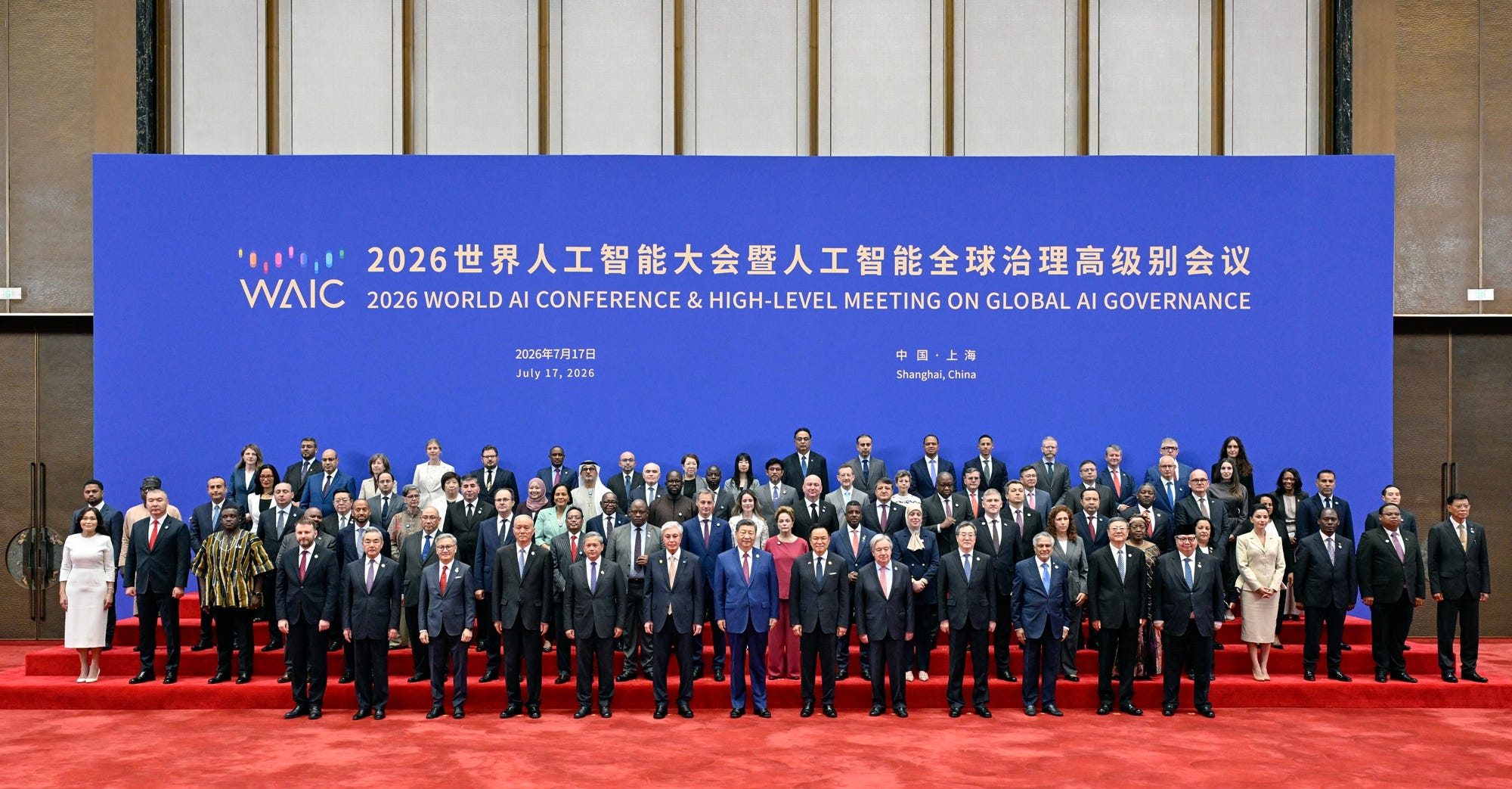
The four proposals he offers are: openness in developing AI, increased awareness of AI risks, pluralism in global AI development according to ‘the unique cultures of individual countries’, and global cooperation in AI regulation. He then goes on to list China’s record on this, such as its set of AI regulations. On this, Beijing has a lot to say, because it has in fact put in more regulations than other countries, despite the prevailing idea in the West that China is out to push the frontiers of AI in another arms race with the US. The story is more complicated than that (and I highly recommend Matt Sheehan’s newsletter to keep abreast of developments).
All of this sounds pretty good to those concerned about AI but realistic that it cannot be put back into the bottle. And that’s what the Today programme was saying too. Of course, as China watchers, we may doubt if Xi really means what he’s saying, knowing that Chinese speeches are almost always saying the right things, but that the reality doesn’t always match up.
But on AI, another part of China’s good week has been the release of Kimi K3 on Thursday. This is the newest large language model from the Beijing-based start-up Moonshot, which claims to approach the capability of American frontier labs like Anthropic. I haven’t tried it much yet but you can for yourself on kimi.com.
As well as China closing the eight to 12 months gap that many American industry insiders estimate lies between American and Chinese AI, the release of Kimi is also instructive for two other reasons. One, it is a sign, as with DeepSeek’s r2 release last year, of what Chinese labs can do even with American export controls on the most advanced chips. Two, it is yet another open-source, cheaper-to-run and modifiable Chinese model that is competing for market share against the closed-source American rivals. Companies and countries are already turning to Chinese models for cheaper AI infrastructure. These models may not be as cutting edge as Anthropic or OpenAI’s offerings, but for large-scale usage, good enough is good enough.
And then, the final boon for Beijing came with the new survey from the Pew Research Center. It comes at this time of year most years, and the latest shows that, for the first year, international respondents (across 20 countries) view China more favourably than America.
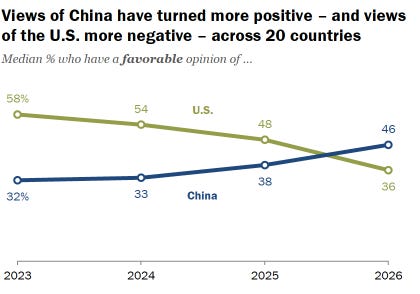
This is mostly a result of a continued worsening of America’s reputation, a trend I wrote about this time last year. Pew’s survey isn’t able to show the cause of why that decline has continued in the last 12 months, though we can take a not-wild guess: Trump’s threats against Greenland, against Canada; his real actions in Venezuela and then in Iran, which has held the entire world economy and fuel supplies as hostage, etc etc. The graph below shows the relative esteem in which people of different countries hold China versus the US.
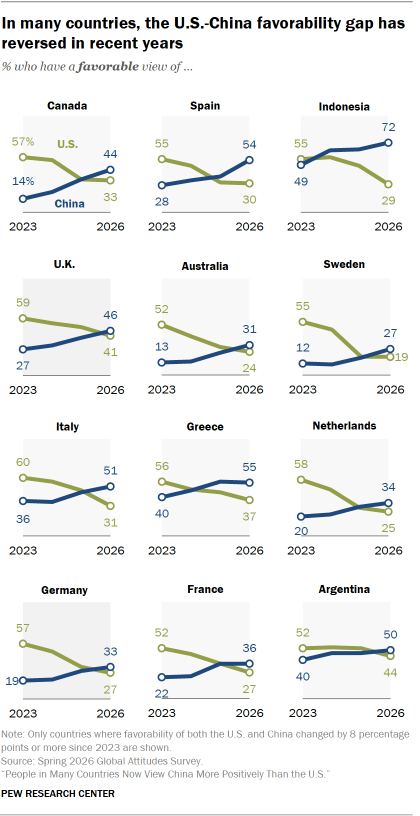
All countries and leaders have good and bad weeks, and by Trump’s metric, last week probably wasn’t even bad. But in terms of global public opinion, I think it is worth noting how last week neatly juxtaposed China’s improvement in reputation with America’s mess. I don’t say this with glee – the usual caveats about China’s economy, tech development, civil liberties, etc apply – but it is always worth tracking public and establishment opinion.
I think the big question now is how much this American reputation decline is limited to the Trump presidency, and whether a successor (even if they come from the Maga camp) can mend ties with other western nations and developing nations. That is still unanswered as of now.
What I’ve been reading/listening to:
Commentary: China’s Rocket Recovery May Mark a Space Industry Inflection Point – Yang Qinghong for Caixin. On the issue of a tech arms race, this analysis in Caixin was really interesting on why the return of the Chinese rocket booster is worth noting: not because the development in and of itself is a milestone, but because of what it signifies for the economic viability of the space industry in China.
Expelled from China – Vivian Wang for the New York Times. Wang writes about being kicked out of China earlier this year after she interviewed Taiwanese president Lai Ching-te. It’s a massive shame as her journalism was often about the human stories that you can only get on the ground, and which humanise China. I have to say, this is a scenario I often think about in my own context – that one day I might not be able to return to China – and Wang’s experience is just another reminder that it is a possibility to come to terms with.
U.S.-China Relations Are More Volatile Than Ever – Andrew Scobell and Andrea Ghiselli for Foreign Policy. A compare-and-contrast of the hollowing out of institutions in their respective countries by Trump and Xi, and what it means for bilateral relations.
What happens when one leader can't keep his mouth shut, and another knows when to keep quiet. I don't need to add the names; we know which is which! I have to say, though, I'm a little surprised by the polling results. I expected the decline in the repuation of the United States. It doesn't automatically follow, though, that China's reputation would rise as a result.
Vivian Wang did not personally record an interview with Taiwan's president, but her employer did, and publicized it to a wide audience. Unfortunately she was blamed for it nevertheless.